
According to epidemiological research, over 90% of Poles have vitamin D deficiency. A lack of this component in the diet increases the risk of, among others, diabetes, depression, multiple sclerosis, or cancer. Therefore, even healthy individuals should consider vitamin D supplementation.
Contents
- Vitamin D Deficiency in Poland. The Deficit is Enormous
- Valuable Vitamin D: What Does Scientific Research Say?
- Is it Worth Supplementing Vitamin D All Year Round?
- Replenishing Vitamin D Deficiency. Skin Synthesis or Supplements?
- What are the Symptoms of Vitamin D Deficiency? Key Symptoms
- Does Vitamin D Help with Immunity?
- Vitamin D in Immunity-Boosting Preparations
- Learn the Rules for Proper Vitamin D Supplementation
- What Dose of Vitamin D for Children?
- Vitamin D Dosage for Infants
Although most of us know about its role in preventing rickets and osteoporosis, we still don’t appreciate this substance enough. Is it worth supplementing vitamin D all year round, or only during the autumn-winter period? What are the symptoms of deficiency? Does vitamin D help with immunity? You will find all the answers in this article.
Vitamin D Deficiency in Poland. The Deficit is Enormous
Although are very popular, many people still forget about the most important one: vitamin D. Research indicates that not only in Poland, but also throughout Europe, vitamin D deficiency is an exceptionally common phenomenon. It is found in every age group. Experts alarm that even 90% of Poles function with vitamin D deficiency, defined as 25(OH)D below 30 ng/ml.
This means that doctors and dietitians are increasingly recommending supplementation of this component to patients. Its severe deficiencies significantly increase the risk of developing many dangerous diseases, including cardiovascular diseases, cancers, depression, and autoimmune diseases. Therefore, although vitamin D is mainly associated with preventing rickets in children and osteoporosis in adults, its impact on the body turns out to be much greater.
Valuable Vitamin D: What Does Scientific Research Say?
For many years, it was known that vitamin D deficiencies were associated with rickets in the youngest, and with osteoporosis, fractures, and muscle weakness in seniors. With the advancement of science, further properties of this component came to light. It turns out that vitamin D actually affects the entire body – regardless of age or gender. This is due to the fact that its receptors are present in almost every cell of the human body.
This is particularly important when we consider that vitamin D deficiencies increase the risk of developing lifestyle diseases. Each year, the number of people suffering from diabetes, arterial hypertension, breast and colorectal cancers increases. Furthermore, vit. D plays a significant role in the prevention of autoimmune diseases, multiple sclerosis, rheumatoid arthritis, and even depression.
Is it Worth Supplementing Vitamin D All Year Round?
Many patients ask doctors whether it is worth supplementing vitamin D all year round, or only during the autumn-winter months. The answer is unequivocal.
The primary, natural source of vitamin D is our skin. The human body synthesizes this component through the skin under the influence of sunlight. Unfortunately, Poland’s geographical location does not favor the production of vit. D in adequate amounts. Skin synthesis in our country occurs only from late April to early September – and only on sunny, almost cloudless days between 10:00 AM and 3:00 PM. Another difficulty is the fact that one must be in the sun for at least 15 minutes a day, exposing at least 18% of the skin’s surface – preferably legs and forearms not covered with sunscreen.
Unfortunately, when we consider that such a process will not occur on a cloudy day, we see that skin synthesis is an extremely rare phenomenon. In autumn and winter (and often also in spring), the angle of incidence of sunlight does not allow for it. All this means that for safety, it is worth supplementing vitamin D throughout the year.
Replenishing Vitamin D Deficiency. Skin Synthesis or Supplements?
People with very fair complexions are in an even more difficult position. In their case, regular sun exposure is not recommended, as it increases the risk of developing skin cancer, including melanoma.
However, problems with skin synthesis are observed in almost every modern human. Many of us travel by car and spend our days indoors (even on a perfectly sunny day). Air pollution, protective filters, advanced age, and chronic diseases also do not favor this. This is why both children and adults are widely exposed to vitamin D deficiencies.
Some argue that vitamin D can be obtained from the diet, i.e., fatty fish, milk, or egg yolks. However, its content in food is insufficient, even negligible. As a result, the only way to supplement deficiencies is through regular vitamin D supplementation.
What are the Symptoms of Vitamin D Deficiency? Key Symptoms
Vitamin D is found in many diverse supplements for a reason. It is contained in , immunity, healthy bones, as well as preparations for improving cognitive functions.
This is due, among other things, to the fact that, given the numerous functions of this component in the body, its deficiency presents non-specific symptoms. Therefore, it can be mistaken for other ailments.
The main symptoms of vitamin D deficiency include:
- bone and joint pain,
- worsening mood, depression,
- reduced immunity,
- frequent infections,
- feeling of fatigue and weakness,
- increased hair loss,
- memory and concentration problems,
- difficulty falling asleep, waking up,
- cognitive impairment.
Significantly, its supplementation is also recommended in the treatment or prevention of certain diseases, such as osteoporosis, diabetes, dental and periodontal diseases, seasonal depression, and hyperparathyroidism.
Does Vitamin D Help with Immunity?
Vitamin D affects not only the condition of teeth, bones, and joints. In fact, it regulates calcium-phosphate metabolism. It is true that its deficiency in children leads to rickets, and in adults – osteomalacia, osteoporosis, increased risk of bone fractures, muscle weakness, or bone pain of varying intensity.
However, vitamin D also affects the immune system. It exhibits strong immunomodulatory activity. It interacts with VDR receptors, which are present in immune system cells (especially T and B lymphocytes, macrophages, dendritic cells). Thus, it participates in:
- inhibiting the excessive expression of pro-inflammatory cytokines,
- stimulating the production of antimicrobial proteins (including in T and B lymphocytes, monocytes),
- stimulating interferon activity,
- stimulating the production of anti-inflammatory cytokines.
Therefore, does vitamin D help with immunity? Absolutely. It actively stimulates our immune system, protecting against the development of diseases and infections.
Vitamin D in Immunity-Boosting Preparations
It is therefore not surprising that high-quality very often contain this valuable ingredient. It is used both as an additive to vitamin preparations and in the form of single-ingredient products, e.g., in the form of vitamin D drops.
A vitamin D supplement is intended to, among other things:
- strengthen the body’s immunity,
- improve mood and well-being,
- enhance memory and concentration,
- prevent the development of many diseases,
- protect against hypertension and lifestyle diseases.
Learn the Rules for Proper Vitamin D Supplementation
Over-the-counter vitamin D supplements contain various doses of this substance. They also come in different forms. In pharmacies, you can find products in the form of drops, capsules, tablets, and even aerosols.
- According to general guidelines, adults should take this component in an amount of 2000-4000 IU/day. For seniors over 75 years of age, the recommended dose is 3000-6000 IU daily depending on the level in the body. With a higher supplementary dose of vitamin D, it is advisable to add more magnesium (e.g., BestMag) to the diet and vitamin K2MK7 (e.g., in BestOne).
It is worth remembering that vitamin D belongs to the category of fat-soluble vitamins. For this reason, many preparations come in the form of drops or capsules with added oil. This is also the case with BestLab’s product, Best Vitamin D3, whose specially designed formula has been enriched with natural MCT oil from coconut. Thanks to this, the preparation ensures proper absorption of vitamin D.
What Dose of Vitamin D for Children?
Vitamin D supplementation in children is a necessity, especially when considering the risk of rickets or growth disorders. So, what dose of vitamin D will be appropriate for children?
- Children aged 1-3 years – for healthy children in this age group, daily supplementation with a dose of 1000 IU/day is recommended throughout the year.
- Children aged 4-10 years – for healthy children in this age group, daily, year-round supplementation with a dose of 2000 IU/day is recommended (depending on body weight and dietary vitamin D intake).
- Adolescents aged 11-18 years – for healthy adolescents in this age group, daily, year-round vitamin D supplementation with a dose of 2000-4000 IU/day will be indicated (depending on body weight and intake of this component with the diet).
It is worth remembering that in addition to single-ingredient drops or capsules with vit. D, multi-ingredient preparations with the addition of this substance are also available, such as – a supplement supporting the daily diet in building well-being and immunity in the youngest.
Vitamin D Dosage for Infants
Exposure of a child’s skin to the sun is contraindicated until the age of 3. Therefore, the safest option is oral administration of vitamin D to the child in the form of drops or aerosol. The dosage of vitamin D for infants is as follows:
- 0-6 months of age: 400 IU/day regardless of whether the child is breastfed or formula-fed;
- 6-12 months of age: 400-600 IU/day.
When starting supplementation, it should be conducted under the control of serum vit. D concentration, both during the baby’s hospital stay and in outpatient care.
Later, parents continue to administer vit. D at home. For newborns, special aerosols, drops like or twist-off capsules are available, which are administered directly into the child’s mouth or food. Drops, in particular, are characterized by ease and freedom of use – the amount of vitamin administered can be easily adjusted to the body’s needs, and the liquid form means that swallowing the supplement is not a problem even for toddlers who do not yet consume solid foods. Therefore, vitamin D in drops is chosen by the vast majority of parents.
Sources:
- Rusińska A, Płudowski P, Walczak M et al.: Principles of vitamin D supplementation and treatment – 2018 amendment. Medical Standards – Pediatrics 2018; 15: 531-559.
- Kmieć P, Sworczak K. Benefits and risks of vitamin D supplementation. Forum Medycyny Rodzinnej 2017; 11(1): 38-46.
- Holick M.F., Chen T.C. Vitamin D deficiency: a worldwide problem with health consequences. Am J Clin Nutr 2008; 87 (9 Suppl): 1080S-1086S.
- Kurowska K, Antosik K, Decyk A and Kobylińska M. The importance of vitamin D in the prevention and treatment of depression. Medycyna Ogólna i Nauki o Zdrowiu 2021; 27(2): 121-125
- Muscogiuri G, Tirabassi G, Bizzaro G et al.: Vitamin D and Thyroid Disease: to D or not to D? European Journal of Clinical Nutrition 2015; 69(3): 291-296.
- Quraishi S.A., Camargo C.A., Manson J.E. Low vitamin D status in Europe: moving from evidence to sound of public health policies. Am J Clin Nutr 2016; 103: 957-958.
- https://naukawpolsce.pl/aktualnosci/news%2C399291%2Cekspert-ponad-90-proc-polakow-ma-niedobory-witaminy-d.html
Also check
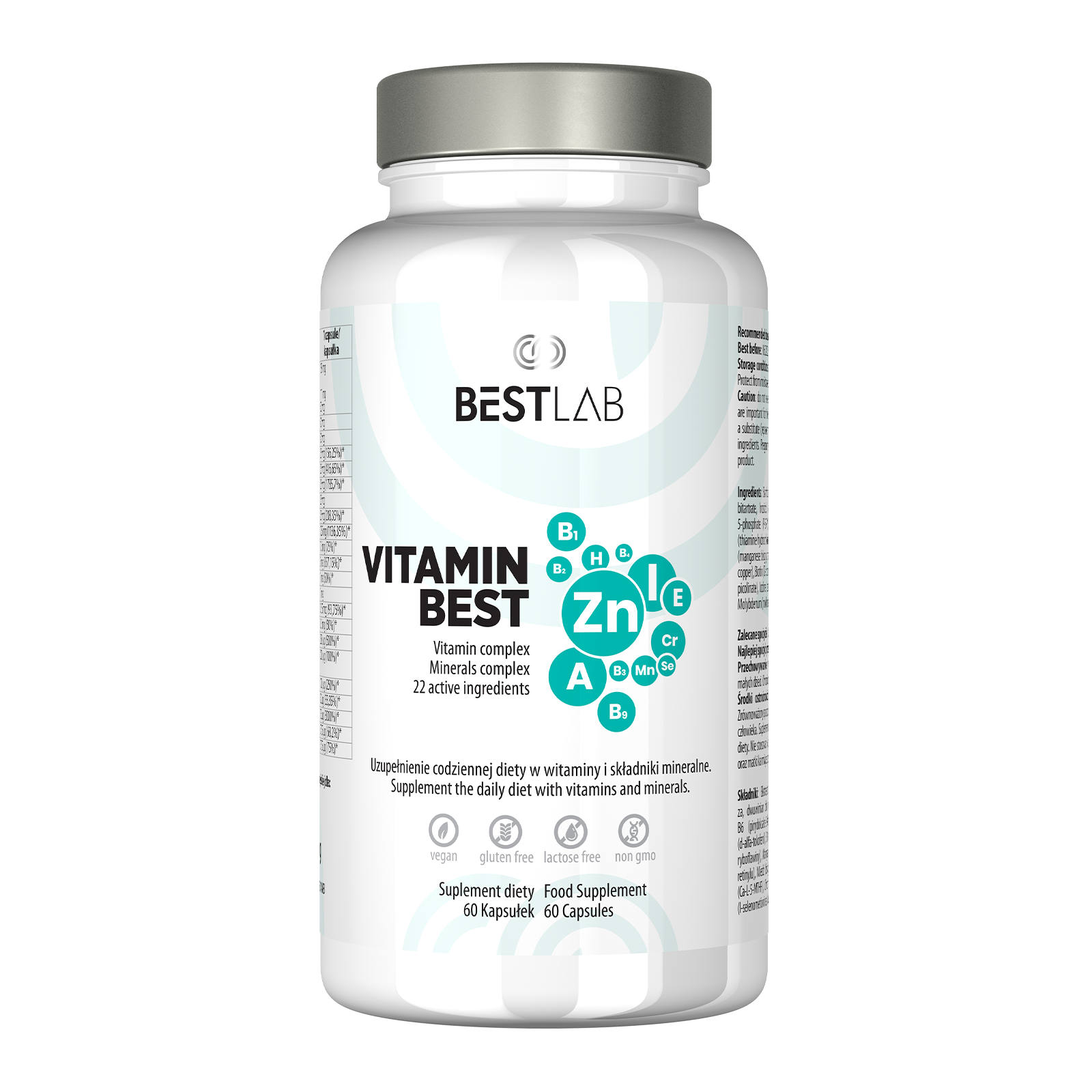
VitaMinBest
£35
View Product →