
The microflora of the digestive tract is a community of diverse gut bacteria that play a very important role in shaping the health not only of the digestive tract but also of the entire organism. Thanks to the proper functioning of digestive processes, absorption of nutrients, and regulation of bowel function, we experience comfort and the ability to function daily. The importance of gut bacteria in the context of preventing many civilization diseases, autoimmune diseases, and more is increasingly being discussed.
Contents
- How does bacterial flora affect the health of the organism?
- Is gut microflora the same for everyone?
- Factors that shape and differentiate each person’s bacterial flora are:
- Why should you care for your gut microflora?
- How to care for our body’s gut microflora?
- Which probiotic to choose for gut microflora health?
- BestBiotic is a multi-strain probiotic that will be ideal for the following conditions:
- Summary
It turns out that the bacteria inhabiting the large intestine (and partly also other elements of the digestive tract) exhibit more properties than might initially seem. Hence, care for the health and homeostasis of the digestive tract is currently so important. It is not without reason that the intestines are called our second brain. Learn about the relationship between the bacterial microflora of the digestive tract and the health of the entire organism.
How does bacterial flora affect the health of the organism?
According to the latest scientific reports, our bacterial flora is inhabited by over 1000 different species of gut bacteria. This means that each species of bacteria affects human well-being in a different way. It is worth adding, however, that among these species of microorganisms, there are also fungi and various types of viruses, which exist in this environment as a natural element living in a kind of ecosystemic balance.
In other words, the environment of the bacterial/gut microflora must exist in a state of balance between individual types of microorganisms, so that the health and well-being of our body are at least at a good level. However, as one might guess, in most people, the state of balance of the gut flora is severely disturbed, which can translate into various types of inflammation and digestive tract dysfunctions.
It is believed that the bacterial flora located in the intestines has a total mass of about 2 kilograms. This means that its mass is very similar to the total mass of the brain. What’s more, many impulses and neurotransmitters from the intestinal environment travel to the brain, where much information is then processed into adequate reactions from the nervous system. Therefore, it can be said that bacterial flora cooperates with our nervous system to determine the state of health and specific reactions to environmental stimuli.
As it turns out, almost 90% of nerve signals originating from the intestines travel to the brain. In the return path, this value is about 10%. This only proves that there is much truth in the saying “Health begins in the gut.” How we behave and function largely comes from signals in the form of neurotransmitters synthesized in the digestive tract. They reach the brain via the so-called vagus nerve, or the gut-brain axis.
Furthermore, a large number of compounds present in the intestinal lumen can be permeable to the bloodstream and further metabolized in the liver, which means that intestinal homeostasis plays a greater role in shaping health and well-being than we might think. This also means that in order to maintain the body and mind in very good condition, one should primarily take care of one’s nutrition, and consequently, the proper functioning of the digestive tract, where gut bacteria are located.
Currently, there is much discussion about the relationship between intestinal dysfunction and tendencies and increased risk of various psychophysical disorders and civilization diseases. The tightness and condition of the intestinal barrier largely depend on the qualitative and quantitative composition of our microflora. Therefore, great emphasis is currently placed on the importance of daily diet and probiotic therapy in disease prevention for the body.
Is gut microflora the same for everyone?
A factor that further highlights the importance of digestive tract microflora is its enormous diversity. Each person has an individual quantitative and qualitative composition of specific bacterial species. This phenomenon can be compared to the individual shapes of human fingerprints.
It is also worth noting that the bacterial flora of the digestive tract influences the expression of individual genes, which is why there is much talk about the links between the quality of bacterial microflora and the tendency and risk of developing various diseases and disorders, including those dependent on genetic factors.
The diversity of microflora means that each person reacts individually to specific elements of their daily diet, behaves differently, and has individual patterns and habits. This makes the science of microorganisms in our digestive tract very extensive.
Factors that shape and differentiate each person’s bacterial flora are:
- age,
- body weight,
- eating habits,
- geographical location,
- genetic factors,
- medications used,
- lifestyle hygiene,
- stress overload,
- past diseases.
It should also be known that over 70% of the bacteria inhabiting the digestive tract are located in the large intestine.
Why should you care for your gut microflora?
The bacterial microflora of the digestive tract plays a significant role in shaping daily health and prevention. It is worth realizing that intestinal dysfunctions often lead to an imbalance in the gut microflora, resulting in various symptoms that generate intestinal diseases, and these, unfortunately, significantly affect our well-being and health.
Digestive tract dysfunctions originate from an imbalance in the composition of the gut microflora. Disruptions in the composition of bacterial flora lead to the following diseases:
- Irritable Bowel Syndrome,
- Excessive constipation or diarrhea,
- Chronic Fatigue Syndrome,
- Inflammatory Bowel Diseases (Ulcerative Colitis, Crohn’s disease),
- Atopic dermatitis, acne, and other skin problems,
- Numerous allergies,
- Lipid disorders,
- Reflux, heartburn, and indigestion,
- Dysfunctions of internal organs,
- Neurological and autoimmune diseases.
As can be seen, the tightness and condition of the intestinal barrier, within which gut flora bacteria are found, plays an enormous role in shaping health and health prevention. Therefore, it is worth starting the repair of the body by improving intestinal function and regulating the qualitative and quantitative state of the bacterial flora.
How to care for our body’s gut microflora?
A very important factor influencing digestive tract health is a low-processed diet, rich in fermented products and high in fiber.
Dietary fiber is an element of individual food products that is not digested by our enzymatic system, but rather serves as a nutrient for gut bacteria in the digestive tract. Fiber is a prebiotic for them, meaning a factor that promotes the growth of positive bacterial microflora. Its action contributes to the quantitative regulation of gut bacteria, which positively translates into well-being and regeneration of the intestinal mucosa. Gut flora bacteria break down fiber into short-chain fatty acids, which are an element regenerating the mucosa and intestinal barrier (including intestinal villi).
The second ingredient that favorably affects the health of the gut microflora is, or rather, are, fermented products. They contain live cultures of probiotic bacteria, which, when regularly supplied to the body, favorably affect the alleviation of inflammation and the regulation of the microflora state.
By including these 2 ingredients in a low-processed diet, we are sure that any potential intestinal inflammation will be reduced, which will then facilitate its remission or complete elimination.
However, it should be remembered that diet is not everything. Providing natural probiotics and prebiotics has a beneficial effect on our health and bacterial microflora, but it may prove insufficient for felt disorders and symptoms. In this case, probiotic therapy is mandatory, which is a therapy involving the regular administration of probiotics containing selected bacterial strains that improve health and regulate the functioning of the digestive tract. The condition, however, is to supply probiotic bacteria in a sufficiently large amount, the effect of which is to induce health benefits for the host organism. Such a comprehensive approach will contribute to significantly faster health effects along with an improvement in well-being and quality of life.
 Which probiotic to choose for gut microflora health?
Among the probiotic preparations available on the market, there is a whole range of products, divided into single-strain and multi-strain probiotics. They differ in the number of probiotic bacteria contained in the capsule. Specifically, multi-strain preparations contain more than one species of bacteria, and consequently, a greater number of CFUs – colony-forming units – can be expected in these probiotics. In other words, the more bacteria in a given probiotic, the greater the overall number of bacteria one can expect in such a preparation.
Multi-strain probiotics are more recommended for regulating the composition of bacterial microflora, as they more comprehensively affect the diversity of bacterial flora and more quickly rebuild the quantitative composition. Their regular intake contributes to a faster perception of health benefits, although some single-strain preparations are excellent for alleviating specific ailments.
Among the best probiotic preparations, available to everyone, is BestBiotic. This is a multi-strain supplement, containing the most thoroughly researched bacterial strains for health prevention and for many functional intestinal disorders. Moreover, BestBiotic contains over 30 billion bacteria in 1 capsule, making it great support for daily care of the microflora and digestive tract. It is believed that the daily amount of bacteria delivered to the intestines should be over 10 billion bacteria. BestBiotic perfectly fits these requirements, thereby improving health, well-being, and body regeneration.
BestBiotic is a multi-strain probiotic that will be ideal for the following conditions:
- Infectious diarrhea,
- Constipation,
- Irritable Bowel Syndrome (IBS),
- Acne and other skin diseases (e.g., Atopic Dermatitis, psoriasis),
- Autoimmune diseases,
- Excessive stress and cortisol,
- Intestinal peristalsis disorders,
- Reflux,
- Lipid disorders,
- Liver function disorders,
- Excessive bloating, gas, and abdominal pain.
Summary
The bacterial microflora of the digestive tract is an extremely important element of the body’s daily functioning. Bacteria primarily inhabiting the large intestine actively participate in the process of digesting food components, influence the correct synthesis of neurotransmitters, regenerate the intestinal mucosa and affect its nourishment, and also regulate the homeostasis of many other tissues in our body. Care for the state of bacterial microflora should be achieved through a low-processed diet with an adequate amount of dietary fiber and fermented products. Furthermore, it is worth conducting probiotic therapy, which actively supports the regulation of the qualitative and quantitative state of gut bacteria, thereby favorably influencing the body’s homeostasis.
- Shi LH, Balakrishnan K, Thiagarajah K, Mohd Ismail NI, Yin OS. Beneficial Properties of Probiotics. Trop Life Sci Res. 2016 Aug;27(2):73-90.
- Thursby E, Juge N. Introduction to the human gut microbiota. Biochem J. 2017 May 16;474(11):1823-1836.
- Fijan S. Microorganisms with claimed probiotic properties: an overview of recent literature. Int J Environ Res Public Health. 2014 May 5;11(5):4745-67.
- Shreiner AB, Kao JY, Young VB. The gut microbiome in health and in disease. Curr Opin Gastroenterol. 2015 Jan;31(1):69-75.
- Quigley EM. Gut bacteria in health and disease. Gastroenterol Hepatol (N Y). 2013 Sep;9(9):560-9.
Check out our offer
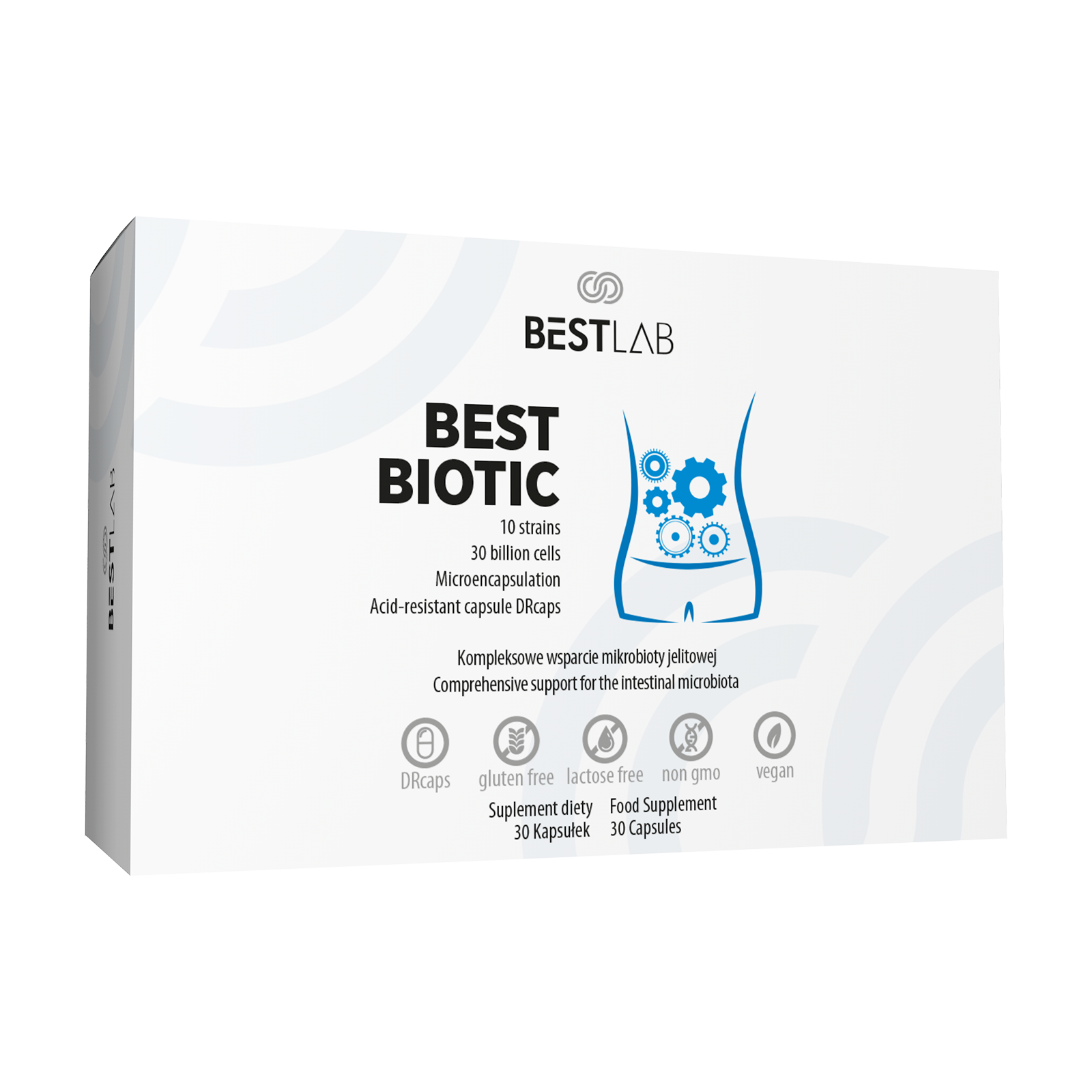
BestBiotic
£31.8
View Product →