
It breaks down sugars, neutralizes toxins, purifies blood – the liver is one of the most “busy” organs in the human body. No wonder it is also one of the most exposed to the harmful effects of substances from which it protects the rest of the body. Fortunately, it is an organ that also has an excellent detoxification system – which we can support, for example, with betaine. How does TMG work and why is it worth using it to support the liver? More on this in today’s article.
Contents
Why does betaine support liver functions?
Betaine (trimethylglycine, TMG) plays a significant role in the proper functioning of the liver primarily through its participation in methylation processes and the regulation of lipid metabolism. In the context of methylation, betaine is a methyl group donor in the reaction converting homocysteine to methionine, catalyzed by the enzyme BHMT (betaine-homocysteine methyltransferase), which is particularly active in the liver. This process is crucial for maintaining the body’s methylation balance, the synthesis of S-adenosylmethionine (SAM) – the main methyl group donor – and for the proper course of detoxification reactions, including the neutralization of xenobiotics and metabolic products.
The second important mechanism by which betaine supports the liver is its influence on lipid metabolism. Betaine participates in the regulation of the synthesis and transport of phospholipids, including phosphatidylcholine, which is essential for the proper secretion of VLDL lipoproteins from hepatocytes. This limits the excessive accumulation of triglycerides in liver cells, which helps protect against fatty liver. Additionally, betaine has been shown to support β-oxidation of fatty acids and improve the metabolic sensitivity of liver cells, making it an important component supporting the regeneration and proper metabolic functions of this organ.
Betaine in Non-Alcoholic Fatty Liver Disease (NAFLD)
In scientific literature, the first attempts to use betaine as a support for people with Non-Alcoholic Fatty Liver Disease (NAFLD) have appeared, although clinical data are still limited and often inconclusive. In pilot and clinical studies, betaine supplementation in doses up to 20 g per day for long periods (e.g., 12 months) proved to be safe and well-tolerated, and in some participants, a tendency to reduce steatosis in liver biopsies and a decrease in liver enzyme activity (ALT, AST) were observed, suggesting a potential hepatoprotective effect. Another randomized, placebo-controlled study in NASH patients showed that betaine could slow the progression of steatosis, although it did not bring significant improvement in the disease activity score or in markers of inflammation and fibrogenesis1. Therefore, despite promising results in animal models and positive signals in humans, further, larger, and well-designed studies are needed to unequivocally assess the clinical effectiveness of betaine in NAFLD.
In terms of mechanisms of action, betaine affects the reduction of liver fat through several dozen metabolic and signaling processes. In experimental models, betaine improves lipid metabolism, among others, by regulating the expression of enzymes involved in fat synthesis and transport, and by stimulating pathways associated with β-oxidation and mitochondrial function 2. Betaine can also modify endoplasmic reticulum stress and improve insulin sensitivity of hepatocytes, which translates into a reduction in de novo lipid synthesis and a limitation of their deposition. As a result, betaine acts multidirectionally – from improving metabolic signaling to direct interaction with intracellular processes responsible for reducing organ fat.
Betaine as a support in detoxification
Betaine supports liver detoxification processes in multiple ways, including through indirect participation in the synthesis of glutathione – one of the most important endogenous antioxidants and a key element of Phase II detoxification. By participating in the methylation cycle and methionine regeneration, betaine contributes to maintaining an adequate level of S-adenosylmethionine (SAM), which is essential for the proper course of the transsulfuration pathway leading to the formation of cysteine, and subsequently glutathione. Adequate availability of glutathione determines the ability of hepatocytes to neutralize reactive oxygen species, toxins, and drug metabolites, protecting liver cells from damage. It can be used alone or supplemented with products containing a complex of B vitamins, such as Best B-complex.
In the context of detoxification support, the synergistic properties of betaine with other active ingredients, such as N-acetylcysteine (NAC, present, for example, in BestNAC) and choline, are also significant. NAC is a direct source of cysteine - an amino acid that limits glutathione synthesis – while choline, like betaine, participates in methylation processes and lipid metabolism in the liver. The combined action of these compounds promotes both efficient glutathione production and the proper functioning of detoxification pathways and the structural protection of hepatocytes, which is particularly important in conditions of increased toxic load or metabolic stress.
Betaine can also cooperate with selected plant extracts with documented hepatoprotective effects, such as artichoke extract or milk thistle, present in liver support supplements, e.g., BestLiver. Bioactive compounds contained in these plants – including cynarin and silymarin – support bile production, stabilize hepatocyte cell membranes, and exhibit strong antioxidant properties. In combination with betaine, which improves methylation balance and cellular metabolism, they can create complementary support for liver function, promoting cell protection against oxidative stress and improving physiological detoxification processes.
Bibliography:
- J. Liu , Y. Liu, Y. Chen et al., Betaine alleviates nonalcoholic fatty liver disease (NAFLD) via a manner involving BHMT/FTO/m6A/ PGC1α signaling, Journal of nutritional biochemistry, no. 134/2024.
- MF. Abdelmalek, SO. Sanderson, P. Angulo et al., Betaine for nonalcoholic fatty liver disease: results of a randomized placebo-controlled trial. Hepatology. no. 50/2009, issue 6.
- L. Abenavoli, G.Aviello, R.Capasso et al., Milk thistle for treatment of nonalcoholic fatty liver disease, Hepatitis Monthly, 11/2011, issue 3.
- M. Ben Salem, K. Ksouda, R. Dhouibi, et al., LC-MS/MS Analysis and Hepatoprotective Activity of Artichoke (Cynara scolymus L.) Leaves Extract against High Fat Diet-Induced Obesity in Rats, BioMed Research International, 2019.
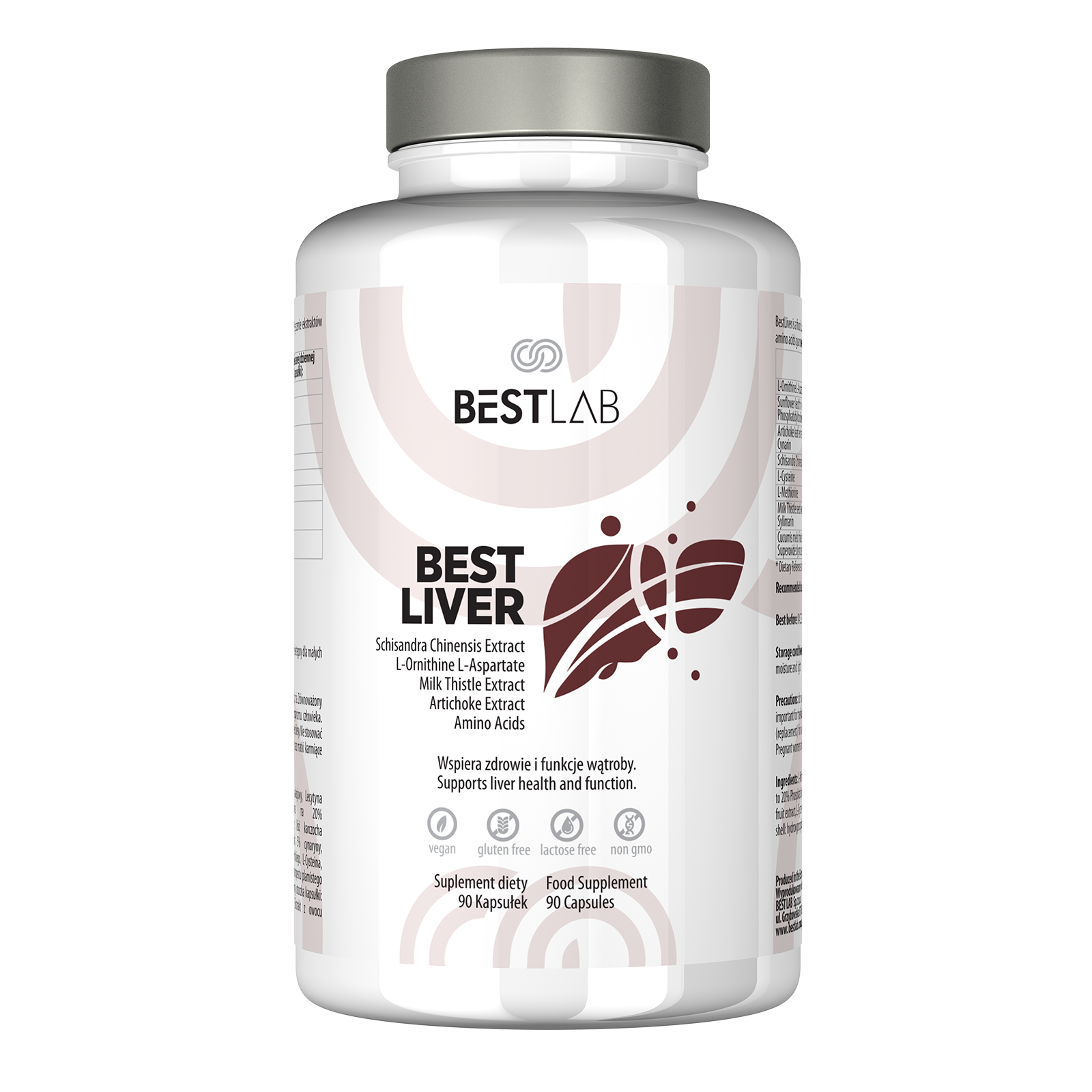
BestLiver
£31
View Product →